


Emerson Hancock has entered the chat. The former first-round pick has been overshadowed by the more established quintet the Seattle Mariners have deployed in the starting rotation the past couple of years, but the right-hander stole the spotlight in the opening series with a six-inning game.
Hancock went six no-hit frames, walked one, and struck out a career-high nine, and it was anything but smoke and mirrors. He sat 93-94 mph (up to 96 early) with his four-seamer, which never looked better than it did in primetime Sunday night at T-Mobile Park, and for me that’s where it all starts.
Hancock came out of Georgia with questions about his fastball shape, which put a lot of pressure on velocity, command, and his secondary stuff. Sunday, we saw a completely different heater. The carry and life on the pitch kept Guardians hitters from squaring it up. The spin rate was up to 2538 RPM, an increase from 2389 a year ago. Spin rate on a four-seam fastball dictates its vertical movement, the rising effect. We see it a lot with George Kirby, Bryan Woo, and Bryce Miller.

Hancock threw his four-seamer 53% of the time in this game, generating nine whiffs on 37 swings (24%). The hardest exit velocity on the pitch was under 80 mph. He threw 69% first-pitch strikes with it.
Hancock also deployed the slider he began working on last spring but rarely brought it out in games. It’s a 77-80 mph slurve — curveball velocity, two-plane slider break — and his feel for it Sunday was a repeat of his spring. On 25 pitches, Hancock induced seven swings on the slider, three of them whiffs. He threw just five two-seamers and five changeups, but both are important pitches for him moving forward.
The value in the zone Hancock generated with the four-seamer was the difference from a pitch standpoint, but his reinvention goes well beyond.
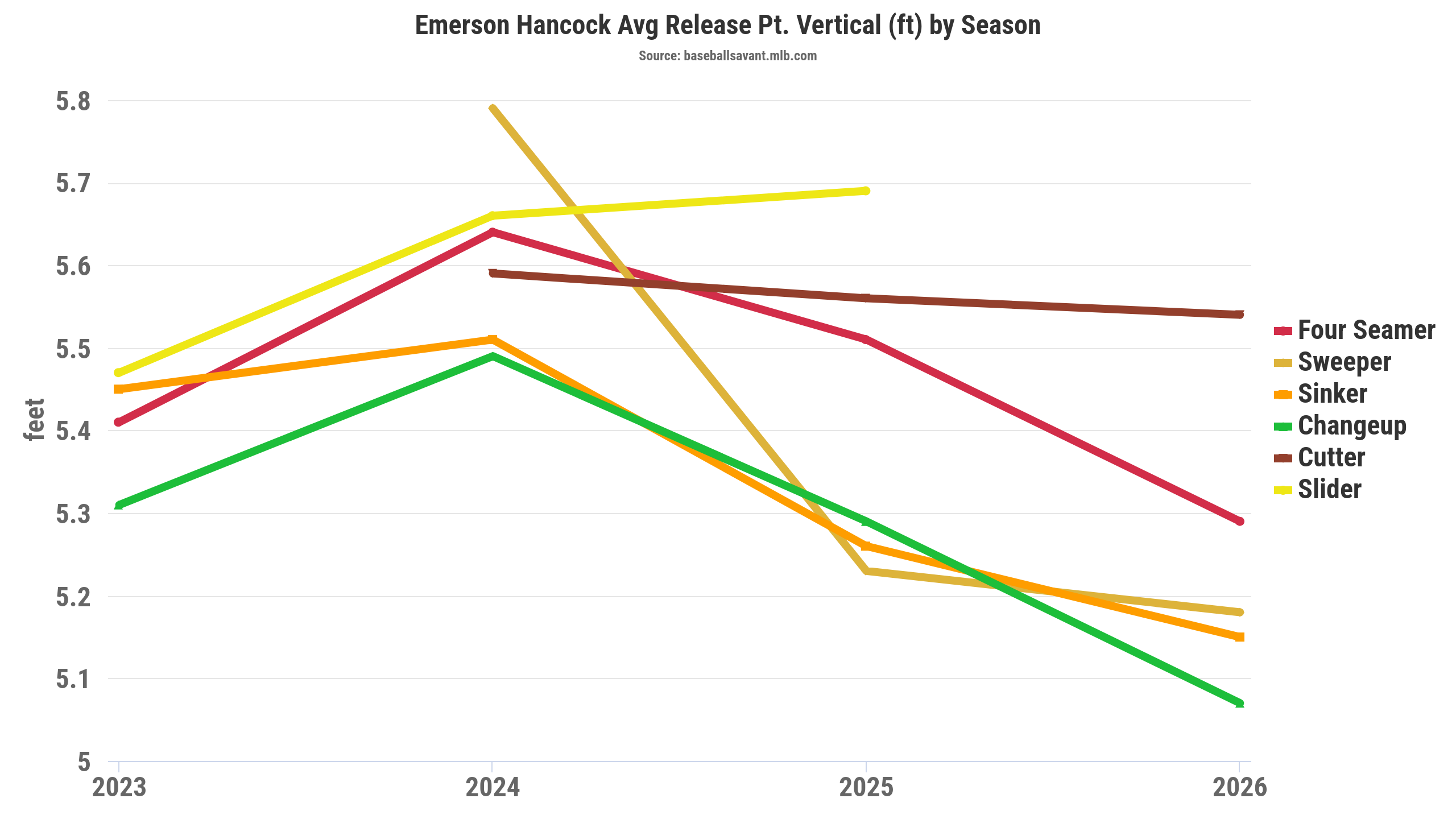
It’s just one start, but his vertical and horizontal releases from Sunday contrasts with the first few years of his career, and hep him create deception to go with the movement on his pitches, a key component.

Vertical release is simply how far off the ground the ball is when it leaves the pitcher’s hand:
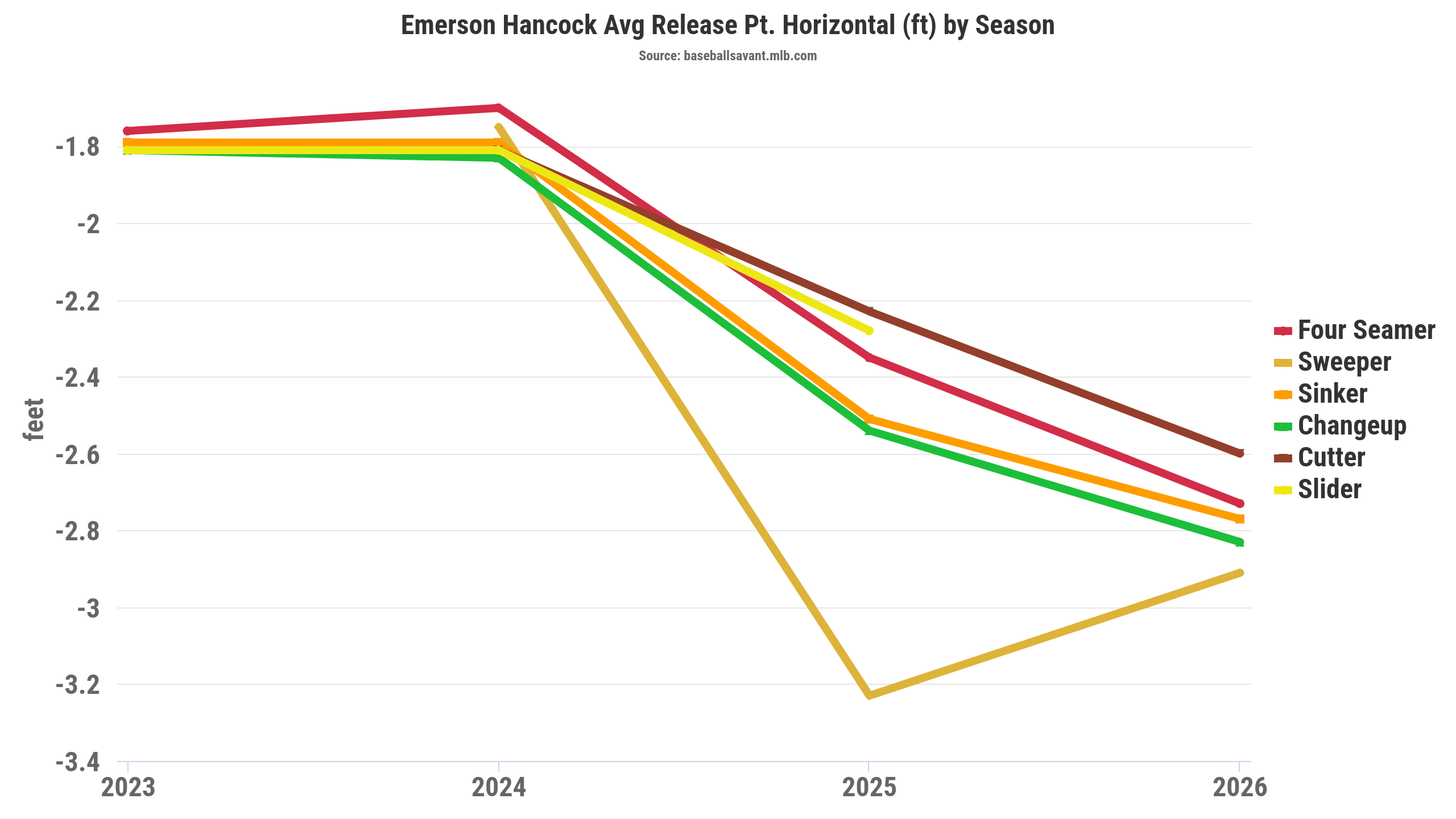
Horizontal release measures how far east-west a pitcher’s release is. For a right-hander such as Hancock, the release is on the third-base side of the mound and toward third baseball. As you can see, Hancock’s horizontal release has crept out further from the pitching slab, creating a different angle, and in start No. 1 of 2026, all of his pitch type show a remarkably-consistent release, helping to avoid tipping pitches while generating the sharper pitch angle:
Hancock also is using a lower arm slot. Arm slot is essentially the path of the arm through release, while vertical and horizontal release metrics are a result of arm angle:
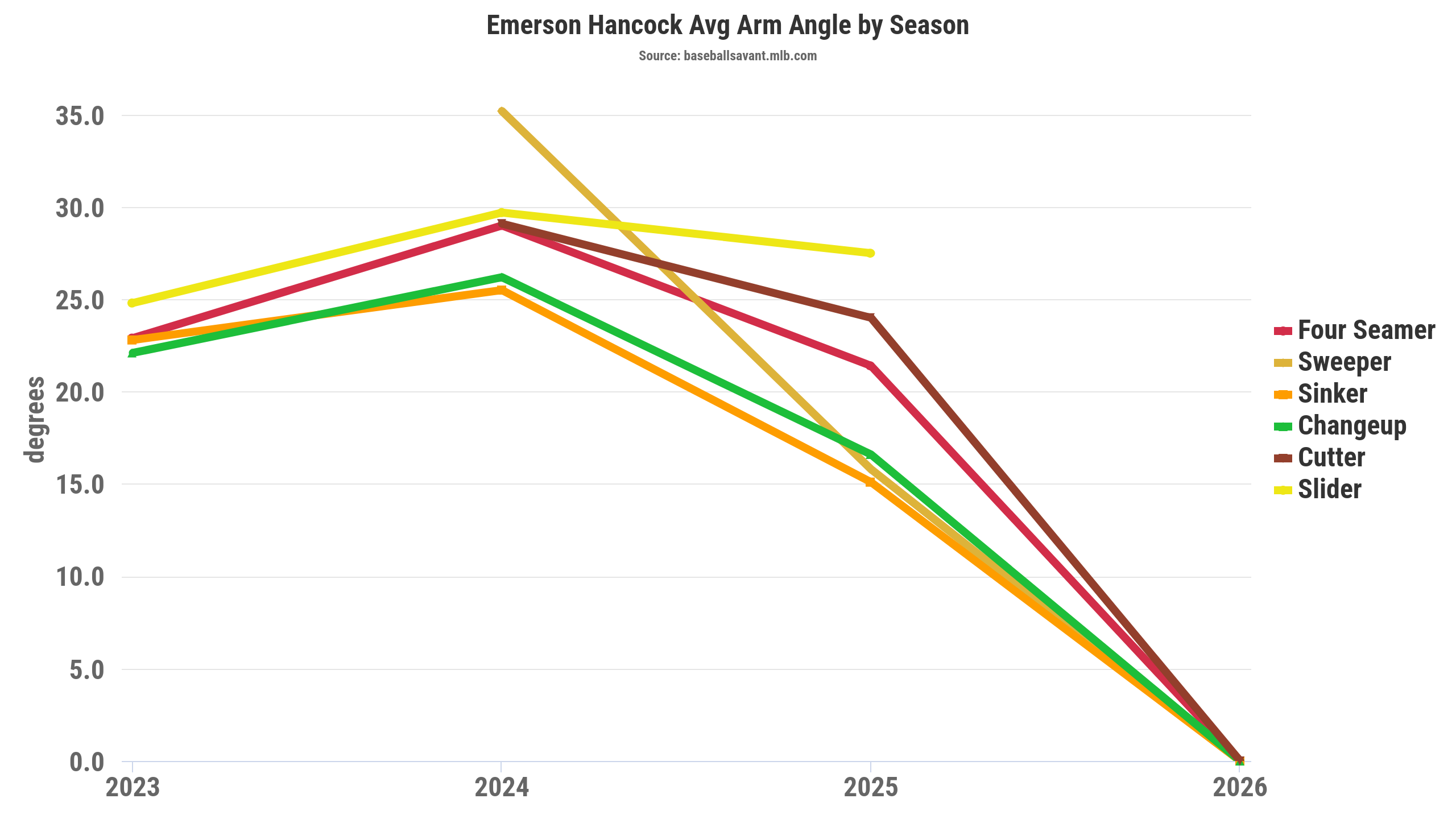
These are significant differences in mechanics and they help explain why Hancock was able to get swings and misses and generate the kinds of in-zone value from his arsenal, particularly the four-seamer. It’s repeatable to a significant degree, too, reliant mostly on Hancock throwing strikes, staying out of the middle of the zone, getting ahead, and executing secondary offerings. At some point he’s going to need his changeup.
Hancock threw 97 pitches, 62 strikes, and generated six groundball outs versus just two in the air. He consistently got back into counts with quality pitch
es, never yielding to the batter, and he didn’t miss his spots much.
The performance was ace-like, but the repeatable execution here is more important — and Hancock isn’t done evolving. Seattle could be looking at another impact starting pitcher in the No. 6 overall pick from the 2020 Draft.


