

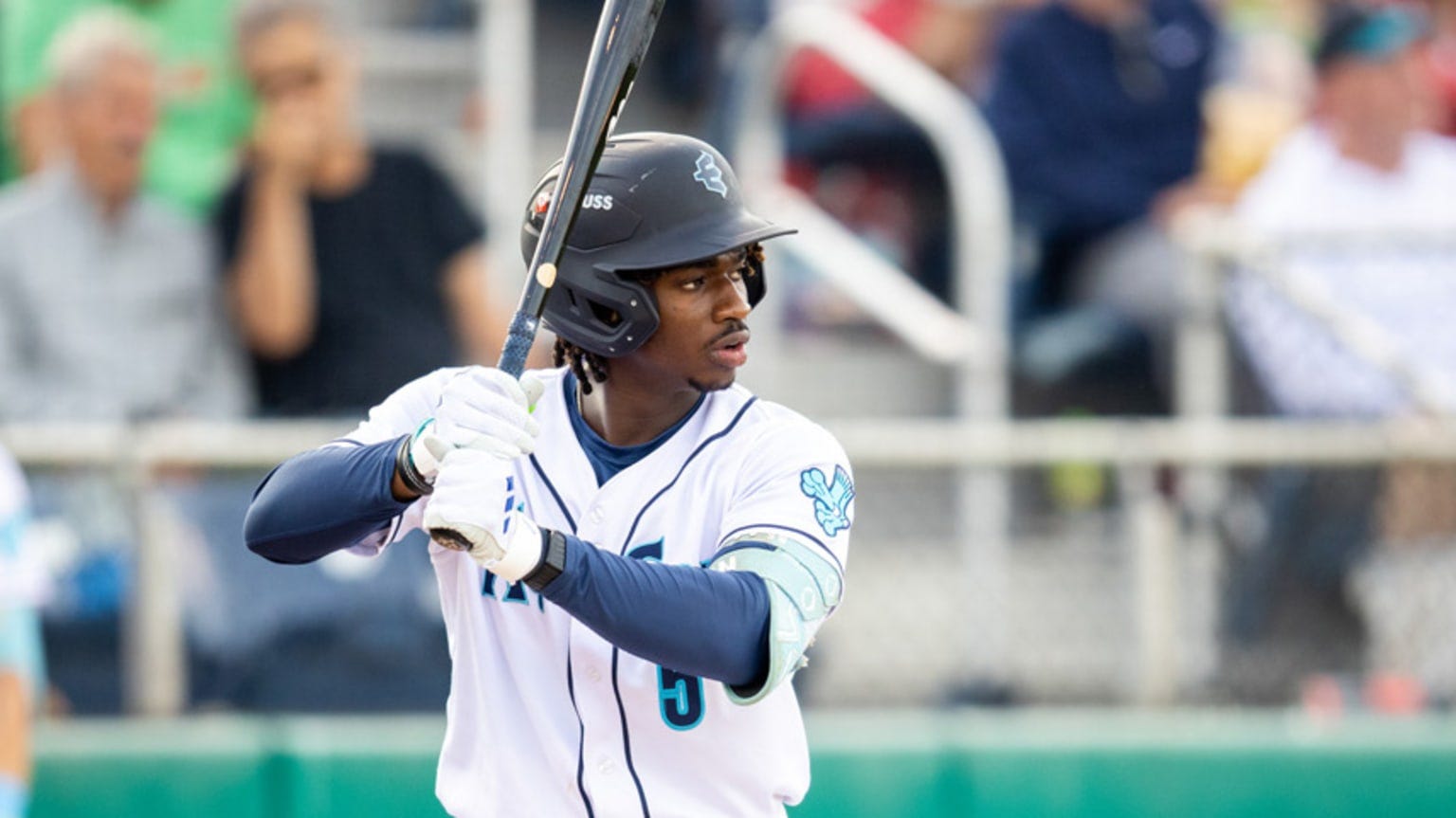
The Seattle Mariners’ top-tier farm system has plenty of strengths, and few weaknesses. Despite some graduations (Cole Young, Carlos Vargas, Ben Williamson, and Logan Evans) and a handful of trades, the system remains in terrific shape.
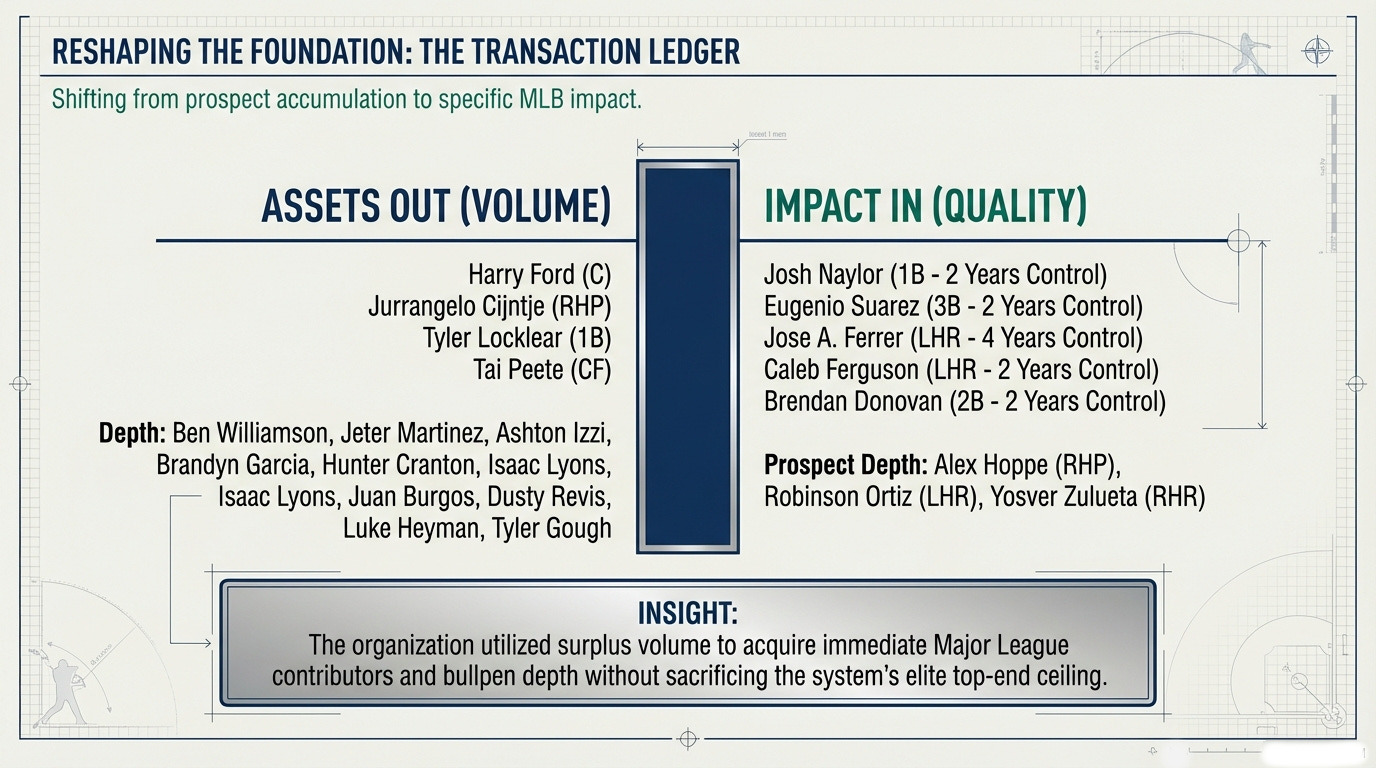
For the record, those trades went like this, as a whole:
Join the Baseball Things Discord (FREE)

Positionally
Up the Middle
Having a bundle of higher-profile, up-the-middle prospects is always a good thing, and Seattle boasts three shortstops (Colt Emerson, Felnin Celesten, Nick Becker), a catcher (Luke Stevenson), and a center fielder (Jonny Farmelo) in their Top 10, followed by two more center fielders at 10 and 12 (Yorger Bautista and Korbyn Dickerson). There are two more catchers in the Top 25 in Grant Jay and Josh Caron.
Starting Pitchers
Not only does Seattle have quality starting pitching in their system, led by two of their Top 3 prospects, all both look like they will debut before the end of 2027, with 2026 looking realistic for 2025 top pick, Kade Anderson.
Ryan Sloan is a rare high-probability prep pick with a year under his belt and the ability to throw strikes with three pitches, perhaps shortening his path to the majors.
Despite the loss of Jurrangelo Cijntje in the trade with the St. Louis Cardinals, Seattle remains well-positioned with their starting pitching.
Griffin Hugus could be the club’s next Bryce Miller — a solid college arm who takes to Gas Camp and develops a secondary pitch he never showed at Miami — and could carry a 2027 ETA.
I’m higher on Christian Little than most, and Mason Peters is an athletic lefty with fastball value who profiles in the bullpen right now, but more strikes and a better pitch for right-handed hitters push him into the No. 4 starter range.
Seattle, considering where they select in the 2026 Draft, will have an opportunity at one or more of the top 10 college arms in the class with their first few picks, thanks to a college-hitter heavy first round. But as-is, they’re in a good spot with two frontline prospects bearing down on the show and just one current starting pitcher over the age of 28 on Opening Day, and none within a year of free agency.
Proximity
Three of the club’s Top 9 prospects reached Double-A a year ago, and the No. 1 prospect got a taste of Triple-A. Anderson has yet to debut, but as a college pick who throws strikes with a full, above-average arsenal, he’s also likely within a year of the show.
Emerson is the potential all-star prize in the system, and after a slow start to 2025, made a few adjustments and was lights out, earning him some time in the PCL late in the season. Quite the jump for a 2023 prep pick.
Lazaro Montes isn’t likely a fast mover from this point on, but it’s double-plus power; he will take walks, and he battled well in Double-A Arkansas in 2025 at age 20.
Weaknesses
Impact Power
Seattle does lack impact corner-defense bats, and for me, there is a lack of impact power overall — though I think Farmelo’s power is being underrated and Stevenson in general is not being given his due as a legitimate Top 20 player in the 2025 Draft class. But outside Montes, Farmelo, and Stevenson, one has to dream a bit to see the big-time extra-base pop.
Bautista has elite bat speed and projects for plus-plus power, but he’s also years away and coming off a season full of mixed results. Rijo has plus raw power, but just signed in January and has as much pro experience as you or I.
It’s not that Emerson, Celesten, and Arroyo won’t hit for any power, but the median projections land somewhere around average for all three.
Peete’s plus raw power comes with significant risk since he’s working on making more contact, and as-is, projects as more of a platoon option or fringe roster player.
The key to this weakness, however, is — it’s not an actual problem.
Probability Depth
The back half of the Mariners’ Top 20 is more about upside and role-player depth than high-probability, near-ready help. It’s not a problem, per se, it’s by design.
Rather than stack up on college players in the draft, more often sacrificing ceiling for some big-league value, Seattle has taken shots at the star.
The Mariners have also avoided trading the high-upside Class-A/High-A prospect for the last three-plus years, allowing them to grow and taking fewer chances on long-term veterans via trade.
The combination of this approach and the lack of payroll flexibility has hurt the club at the MLB level, forcing short-term trades (Kolten Wong), low-ceiling free agent signings (AJ Pollock, Ryne Stanek, Trevor Gott ).
It’s my opinion, however, the club is in better shape in this manner than they were a year ago. The quality of Triple-A prospect depth on the mound is significantly better, including trade acquisitions Alex Hoppe and Robinson Ortiz, and while Korbyn Dickerson is more of a 2027 name, he’s the kind of pick that fills the Pollock-type need and saves the club payroll space that can be spent elsewhere.
Balance & Fit
The system’s greatest strengths are balance and fit. Beyond the talent, the farm’s best prospects not only project to slide into roster openings likely created by late-arb trades and free agency, but the timing of their ETAs and stick years line up well.
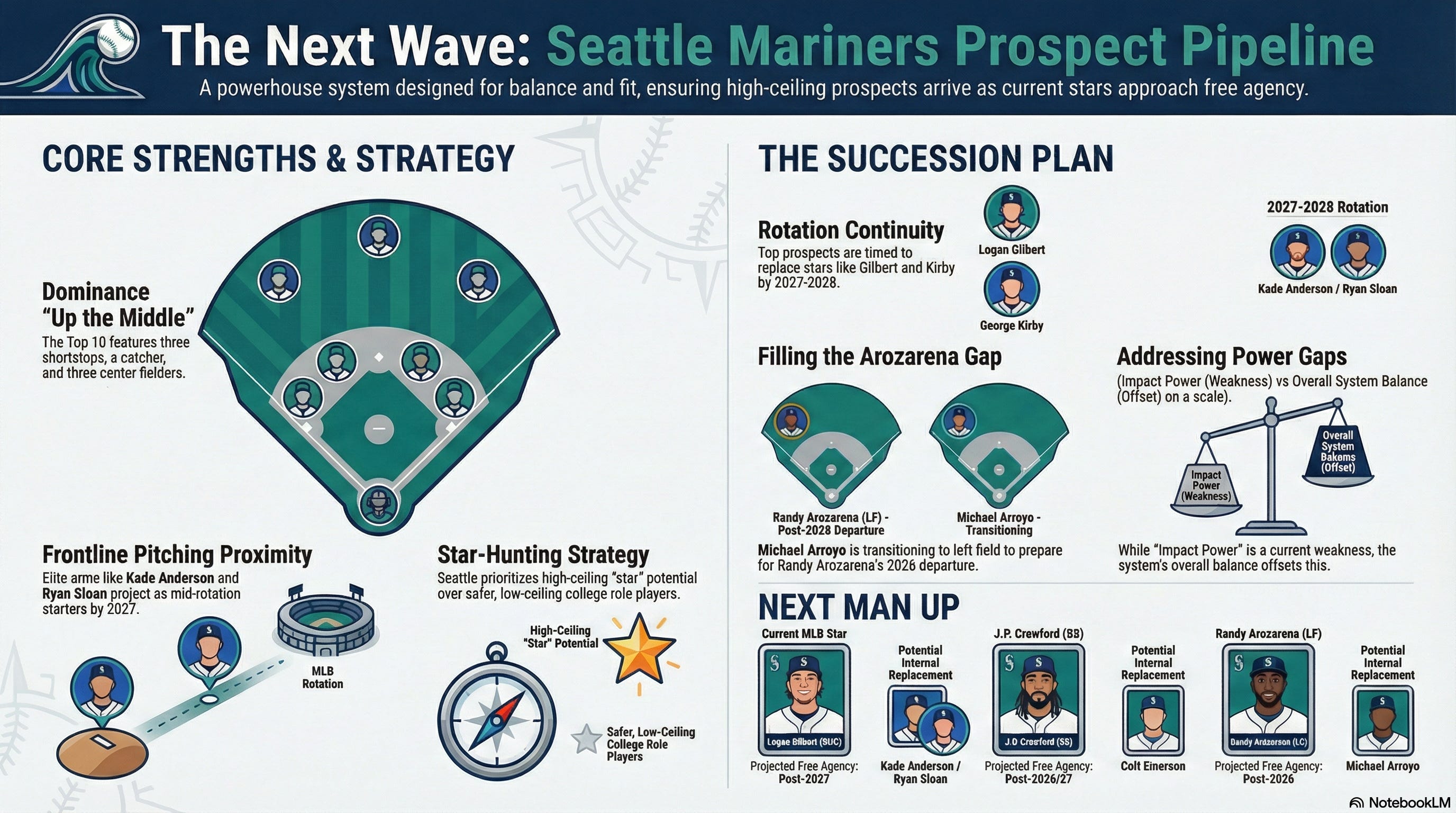
The Mariners know what they’re doing, folks.
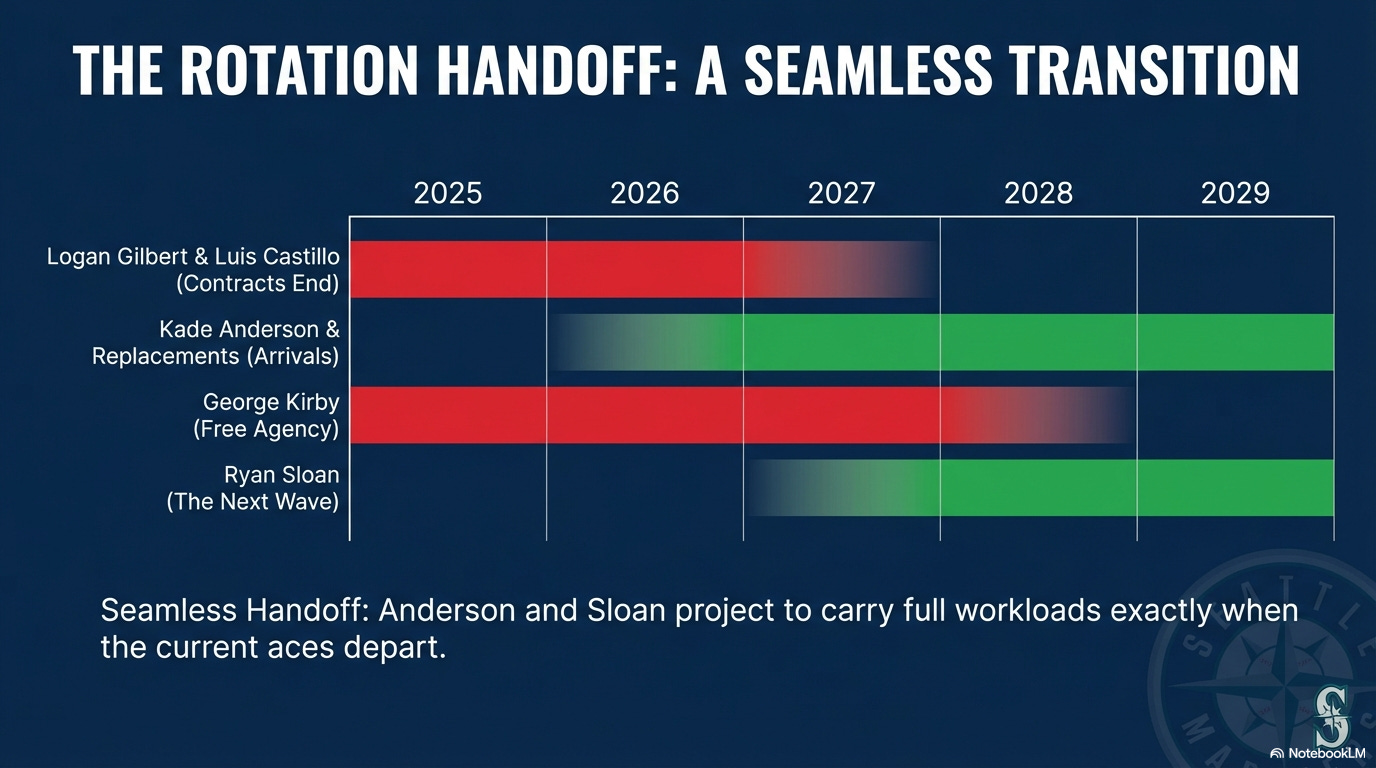
Logan Gilbert may very well be extended, but if he’s not and walks after the 2027 season, he’ll leave with Luis Castillo, who has two years left on his contract. Their replacements (Anderson, Ryan Sloan) project to be ready to shine by then. Anderson carries a 2026 or 2027 ETA, with Sloan a year to a year-and-a-half behind.
George Kirby is slated for free agency a year later, when Sloan likely starts the year in the rotation after debuting in 2028. He could see the bigs in 2027, too, if things go well enough in 2026.
J.P. Crawford’s free agency would be a problem for a lot of clubs. Having a reliable, above-average shortstop is almost imperative in the major leagues. Emerson’s timeline, however, may actually overlap Crawford’s presence, which is why the second and third are in play for the top prospect in 2026 should he rake in Tacoma to start the season.
Randy Arozarena will be a free agent after 2026, and there’s little to no chance he’s extended. Enter Michael Arroyo, whom the club announced this winter will be moving to left field in 2026.
His bat projects better at second, and he’s not going to be the run-producer, power-based offensive threat Arozarena and most left fielders are, but there’s no reason Arroyo can’t hit .260 with a .350 OBP and 45 extra-base hits. While that’s unlikely to happen in 2027, he could hit enough to hold down the position if the roster can support it.
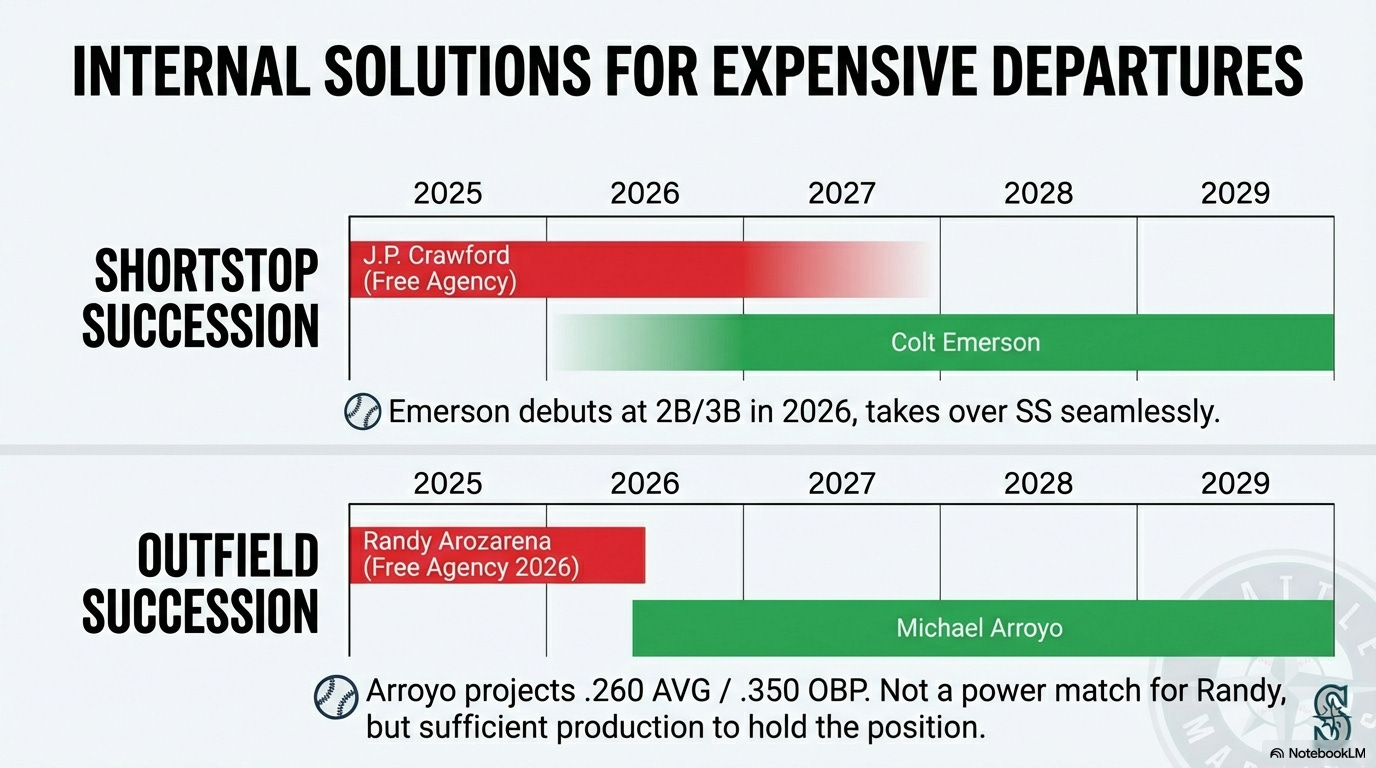
Gilbert, Kirby, Castillo, Crawford, and Arozarena could all leave by the end of 2028, and the Mariners have three reasonable-to-optimal replacements crashing toward the majors right now.
The amazing thing here is the Mariners never drafted for need early. Unlike the NFL, doing so is a terrible idea. But they were able to take the best players, and despite that fact, prospects still find themselves in a position to fill numerous roster spots from within.
